
Why IV Site Selection in the Arm Matters
Successful IV cannulation begins with choosing the right vein. Proper site selection improves catheter stability, reduces complications such as infiltration or phlebitis, and increases patient comfort during infusion therapy.
For nursing students and early-career clinicians, understanding arm-based IV sites is essential before progressing to more complex access scenarios.
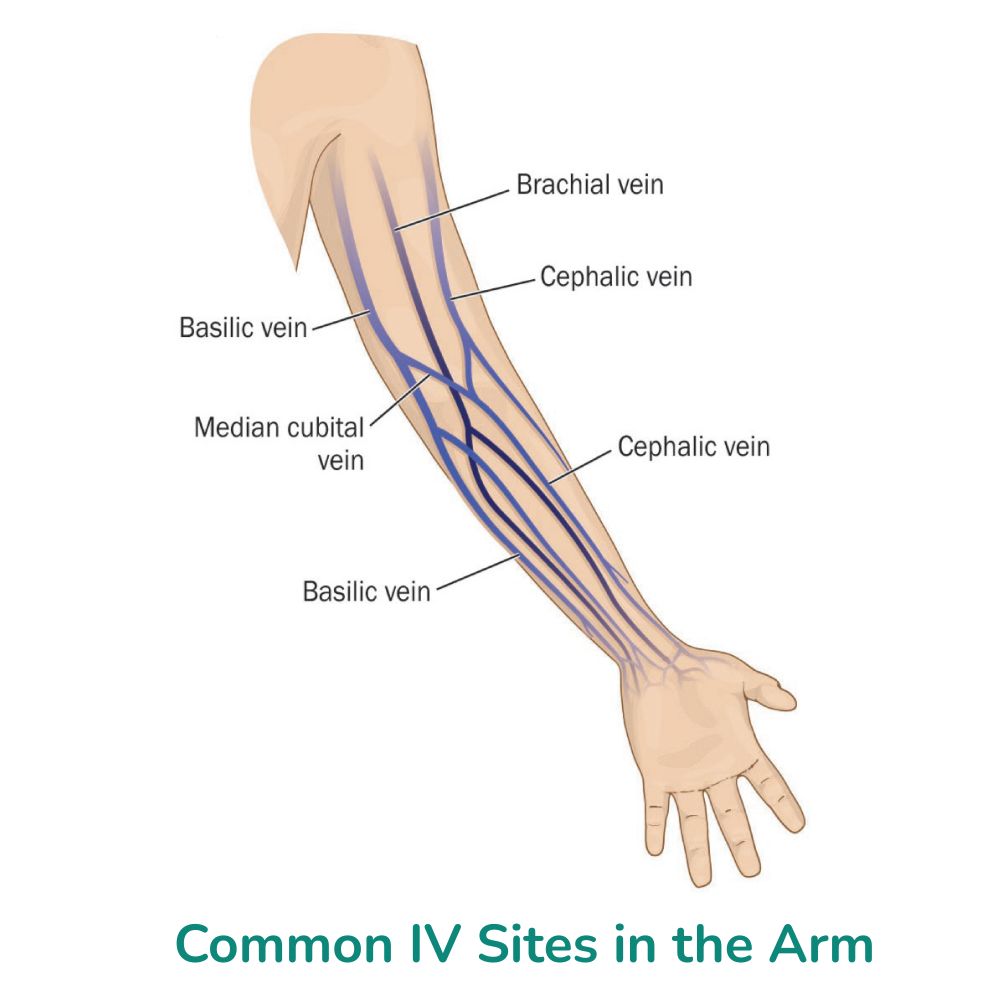
Common IV Sites in the Arm
Understanding common IV sites in arm is crucial. Here are the primary veins used in clinical practice:
1. Median Cubital Vein
Location: Antecubital fossa, connecting the cephalic and basilic veins.
Advantages: Large diameter, easy to palpate, high initial success rate.
Limitations: Joint movement may affect catheter stability during long infusions.
This site is often used for initial IV training to help learners understand catheter entry and flashback recognition.
2. Cephalic Vein
Location: Lateral aspect of the arm and forearm.
Advantages: Consistent pathway, suitable for standard IV catheters.
Limitations: May roll and requires firm anchoring.
3. Accessory Cephalic Vein
Location: Branching from the cephalic vein.
Advantages: Superficial and relatively stable.
Limitations: Smaller diameter limits use for high-flow infusions.
4. Basilic Vein
Location: Medial arm and forearm.
Advantages: Often larger than cephalic vein.
Limitations: Close to arteries and nerves; advanced skill required.
5. Forearm IV Sites
Forearm veins are commonly selected when avoiding joint movement is important.
Benefits:
- Improved catheter dwell time
- Reduced risk of dislodgement
- Better patient mobility
Forearm IV access requires precise depth control, making it ideal for progressive IV training.
Principles for Choosing the Best IV Site
When choosing an IV site, keep the following principles in mind:
-
Vein quality: Soft, elastic, and refillable
-
Therapy duration: Longer infusions require more stable veins
-
Patient factors: Age, mobility, skin condition
-
Skill level: Beginners should start with visible, well-anchored veins
Techniques for Successful IV Insertion
Preparation
- Perform hand hygiene and use aseptic technique
- Apply tourniquet 5–10 cm above the site
Insertion
- Insert catheter at a 15–30° angle
- Lower angle after flashback and advance catheter fully
Post-Insertion Care
- Secure catheter to minimize movement
- Monitor for infiltration or phlebitis
Improving IV Skills Through Structured Practice
IV insertion is a psychomotor skill that improves with repetition. Training with IV practice arms allows learners to:
- Recognize vein resistance and flashback
- Adjust insertion angles safely
- Practice catheter advancement and stabilization
Simulation-based practice bridges the gap between theory and real clinical performance.
Key Takeaways
- Arm veins are the primary choice for peripheral IV access
- Site selection affects catheter stability and patient comfort
- Correct technique and repeated practice are essential for success
Related Articles:
.jpg?w=1600&h=1600)
.jpg?w=1600&h=1600)
.jpeg?w=1600&h=1600)
.jpeg?w=1600&h=1600)
.jpeg?w=1500&h=1500)
.jpeg?w=1500&h=1500)
.jpeg?w=1500&h=1500)
.jpg?w=1600&h=1600)
.jpg?w=1600&h=1600)
.jpeg?w=1000&h=1000)
.jpeg?w=1000&h=1000)
.jpeg?w=800&h=800)
.jpeg?w=1500&h=1500)
.jpeg?w=1500&h=1500)
.jpeg?w=1500&h=1500)
.jpg?w=1500&h=1500)
.jpg?w=1500&h=1500)
.jpeg?w=1500&h=1500)
.jpeg?w=1500&h=1500)
.jpg?w=1600&h=1600)
.jpg?w=1600&h=1600)
.jpeg?w=1000&h=1000)
.jpeg?w=1000&h=1000)