
Mastering intraosseous (IO) access is critical in emergency care when IV lines fail. IO trainers provide realistic practice for needle insertion, infusion, and site localization, helping medical professionals, EMS providers, and students build confidence in life-saving procedures.
Understanding IO Trainers
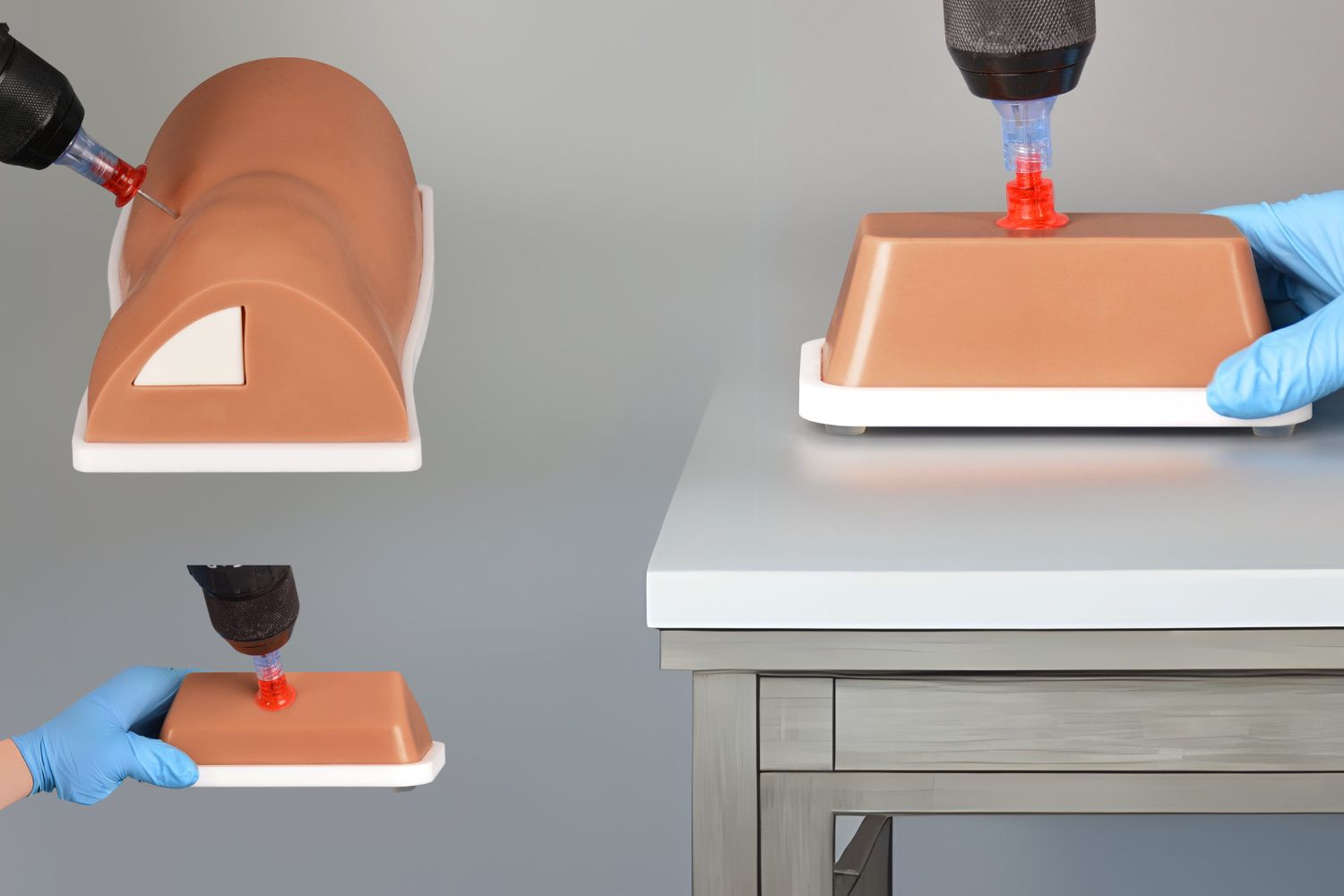
IO trainers, also known as intraosseous trainers, are simulation tools designed to replicate real-world bone access. They allow hands-on practice of:
- Intraosseous needle insertion: Accurate placement of the IO needle into the bone.
- Intraosseous access: Establishing a secure bone marrow route for fluid or medication delivery.
- Intraosseous infusion and injection: Practicing medication or fluid administration through a functional IO line.
By mimicking realistic tactile resistance and anatomical landmarks, IO trainers give learners a true-to-life experience, bridging the gap between classroom knowledge and real clinical practice.
For high-quality models, explore Ultrassist's IO trainer collection to find infant, pediatric, and adult options.
Key Factors When Choosing an IO Trainer
1. Anatomical Accuracy and Site Simulation
Look for trainers that replicate common intraosseous access sites, including the tibia, humerus, femur, and sternum, across infant, pediatric, and adult anatomies. Realistic landmarks like the tibial tuberosity improve site localization skills.
2. Realistic Skin and Bone Resistance
High-fidelity trainers offer authentic needle feedback with silicone skin layers and bone-like resistance, allowing repeated practice of insertion angles and pressure without compromising realism.
3. Compatibility and Reusability
Ensure the IO trainer is compatible with systems like EZ-IO® and includes replaceable bone inserts for cost-effective, long-term training. Reusable models support high-volume use in EMS, hospitals, or classrooms.
4. Ease of Use and Portability
Compact, portable trainers with stable anti-slip bases enable smooth practice sessions anywhere, from simulation labs to field training scenarios.
Benefits of Using IO Trainers
- Develop critical emergency skills before performing procedures on real patients.
- Gain confidence in needle control, insertion angles, and site accuracy.
- Practice high-pressure pediatric and adult scenarios safely.
- Improve team-based emergency response during trauma or resuscitation drills.
By integrating IO trainers into training programs, learners can master intraosseous access quickly and efficiently.
Choosing the right intraosseous trainer ensures reliable skill development for needle insertion, access, injection, and infusion. Ultrassist IO trainers provide realistic anatomy, tactile feedback, and versatile training scenarios to prepare medical professionals for real-life emergencies.
Ready to enhance your IO skills? Explore Ultrassist IO trainer collection today.
FAQs:
Q1: Why choose an IO trainer instead of just practicing IV?
A1: IO trainers let learners practice intraosseous access when IV access is difficult or impossible. They simulate real bone resistance and anatomical landmarks, providing hands-on training for needle insertion and infusion. Learn more about Ultrassist IO Trainers and their realistic training features here.
Q2: Which IO access site is best for training?
A2: Common training sites include the proximal tibia, humerus, femur, and sternum. Ultrassist IO Trainers offer multi-site simulation across infant, pediatric, and adult models, ensuring comprehensive practice. Explore all site options in our IO Trainers FAQ.
Q3: Can nurses safely practice IO insertion with these trainers?
A3: Yes. Ultrassist IO Trainers are designed for medical professionals, students, and EMS personnel to practice safe and correct needle insertion before performing clinical procedures. Details are available in our IO Trainers FAQ.
Q4: How do you start an IO line during emergency training?
A4: Starting an IO line involves selecting the correct site, inserting the needle at the proper angle, and confirming placement. Ultrassist IO Trainers simulate realistic insertion techniques, providing tactile feedback for confident skill development.
Q5: How long can IO access be maintained?
A5: Clinically, IO lines are typically used for short-term emergency access until IV access is achieved. Training with Ultrassist IO Trainers focuses on accurate placement, needle control, and infusion techniques.
Q6: Is IO faster than IV for emergency access?
A6: Yes. IO access can be established quickly when IV attempts fail, which is why practicing on realistic IO Trainers helps learners build confidence and speed.
.jpg?w=1600&h=1600)
.jpg?w=1600&h=1600)
.jpeg?w=1600&h=1600)
.jpeg?w=1600&h=1600)
.jpeg?w=1500&h=1500)
.jpeg?w=1500&h=1500)
.jpeg?w=1500&h=1500)
.jpg?w=1600&h=1600)
.jpg?w=1600&h=1600)
.jpeg?w=1000&h=1000)
.jpeg?w=1000&h=1000)
.jpeg?w=800&h=800)
.jpeg?w=1500&h=1500)
.jpeg?w=1500&h=1500)
.jpeg?w=1500&h=1500)
.jpg?w=1500&h=1500)
.jpg?w=1500&h=1500)
.jpeg?w=1500&h=1500)
.jpeg?w=1500&h=1500)
.jpg?w=1600&h=1600)
.jpg?w=1600&h=1600)
.jpeg?w=1000&h=1000)
.jpeg?w=1000&h=1000)